



In the field of education, STEM education has become an important model for cultivating future talents. It breaks the boundaries of traditional disciplines, deeply integrates the four major fields of science, technology, engineering, and mathematics, and cultivates students' innovative thinking and practical ability through project-based learning and problem-solving-oriented methods. Unlike traditional teaching models, STEM focuses on creativity, cooperation, and critical thinking.

Importance of STEM education to students?
1. Cultivate critical thinking and problem-solving skills, enhance creativity and logical thinking
STEM education helps you think logically and come up with creative solutions. When you engage in hands-on tasks such as programming or building robots, you can not only solve problems but also improve your thinking skills. Asking questions and verifying ideas can help you learn how to solve challenges. For example, creating renewable energy in the field of science requires a combination of chemistry, physics, and engineering. This combination can stimulate creativity and promote logical thinking.
2. Help students solve real-world problems
STEM education aims to cultivate your ability to deal with the world's problems. By combining STEM with other disciplines, you can look at problems from different perspectives and think about ethical issues. Whether you are verifying ideas in the field of science or studying data, STEM can cultivate your problem-solving skills. These skills will help you deal with challenges such as climate change, healthcare, and sustainable development.
3. Practical projects build confidence and curiosity
Participating in STEM projects can help you increase your confidence and curiosity. Success in tasks such as experiments or group projects shows that you have the ability to learn and achieve. Practical learning connects academics to success in real life and cultivates leadership and perseverance. For example, teamwork activities can boost your confidence and prepare you for future work.
4. Encourage adaptability and continuous learning
STEM education teaches you to keep learning and adapt to change. Participating in practical projects can develop skills to solve real problems. Whether in the laboratory or in team activities, STEM can help you develop a lifelong learning mindset. This flexibility allows you to respond to the changing needs of STEM careers at any time.


As a manufacturer of DIY wooden crafts, our products can be deeply integrated into STEM education scenarios and show unique value.
- Taking a wooden dollhouse as an example, students can plan the proportions and area of the house based on mathematical knowledge, and design a stable house structure through engineering thinking; during the construction process, they can use scientific knowledge to understand the characteristics of wood, and use programming technology to add technical elements such as smart lighting and music to the dollhouse to cultivate multidisciplinary integration capabilities.
- Wooden booknooks also have unlimited potential. Students can use mathematical knowledge to measure the size of books and design booknooks shapes that conform to the principles of mechanics; optimize the bookend structure through engineering design to enhance the load-bearing capacity; during the production process, explore the scientific characteristics of wood and different connection methods, and turn simple booknooks into carriers of STEM practice.
- Wooden puzzles are also high-quality tools to stimulate STEM thinking. The design and production of puzzles involve the deconstruction and reorganization of graphics in mathematics and the design of splicing fit in engineering. In the process of puzzle making, students can exercise their spatial thinking and logical reasoning abilities by observing patterns and analyzing structures. If puzzles with popular science knowledge are developed, such as biological evolution maps and physical phenomenon diagrams, scientific knowledge can also be integrated into them, allowing students to gain knowledge through hands-on practice.
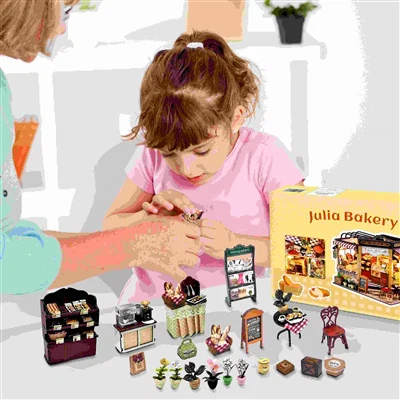


The role of Hongda-diy wooden crafts in the STEM field
1. Enhance hands-on learning and creativity
Hongda-diy wooden crafts are very suitable for hands-on learning of STEM knowledge. These DIY hands-on processes can stimulate creativity, imagination and critical thinking. They can help you focus on solving problems. Problem solving requires patience and logical thinking, thereby developing strong STEM skills.
2. Encourage teamwork and problem solving through participating activities
It can cultivate the spirit of teamwork. You can solve challenges together just like in the real world. This kind of teamwork can help you learn team communication and problem solving. Building things together is fun and also reflects the importance of teamwork in the STEM field.
Integrating DIY wooden dollhouses, booknooks, and puzzles into STEM education not only enriches the form of educational practice, but also injects educational connotations into our products. In the future, we will continue to explore more innovative integration solutions to bring more interesting and educational products to students, help the development of STEM education, and open up a broader market space for brands.
