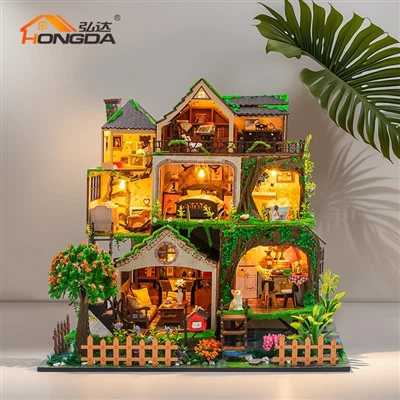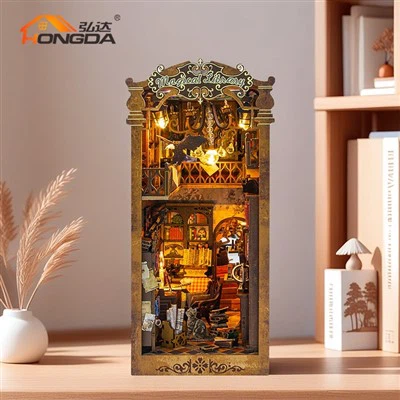


Assembling a DIY toy house with your child not only enhances their understanding of development, relationships, and creativity, but also brings benefits that go far beyond the finished product itself.

1. Stimulate creativity and imagination
Design freedom and artistic exploration
Children can customize the decoration, furniture placement, and color scheme of the toy house to show their personal style. Choosing miniature accessories to make DIY furniture can cultivate children's hands-on ability.
2. Cultivate cognitive and practical skills
Spatial reasoning and problem-solving skills
Assembling a toy house requires understanding how the various parts fit together (for example, fixing the wall to the base, adjusting the position of the stairs), which enhances children's spatial awareness.
3. Patience and attention to detail
DIY toy houses often require step-by-step instructions and tedious tasks (for example, sticking small stickers), which requires children to focus on details and persist in completing complex steps. This patience can be transformed into the patience needed for learning and practical operations.
4. Strengthen parent-child relationships: teamwork
Parents and children can divide the work according to skill level: adults are responsible for cutting wood or using hot melt glue guns, and children are responsible for painting or decorating. This division of labor can cultivate a sense of shared responsibility.
5. Quality "unplugged time"
Building a toy house can create an environment away from electronic screens where families can chat, laugh, and collaborate together, and focusing on a goal together can promote meaningful interactions.
6. Promote emotional and social development: Emotional regulation and self-confidence
Overcoming challenges in the assembly process (e.g., a part doesn't fit) can teach children how to deal with frustration. When parents lead by example and calmly solve problems (e.g., "Let's take a break and look at the instructions again"), children can learn healthy coping strategies. Completing a task can also improve self-esteem.
Assembling a DIY toy house with children is a multifaceted activity that can cultivate creativity, enhance relationships, and teach practical skills. From the first cardboard cut to the final placement of the miniature lights, each step provides opportunities for learning and connection. Whether it is turning a simple cardboard box into a cozy home or a sophisticated wooden set, the process-and the fun-filled world it creates-becomes a concrete symbol of family cooperation and children's imagination. By investing time in this DIY project, parents are not just building a toy house; they are also creating memories and foundations for their children to grow up.
Products Recommend